The Timothy Dalton Era

6th August 2013
On this day in 1986, Welsh actor Timothy Dalton was officially announced as the fourth James Bond. MI6 looks back at his 007 era
 By MI6 Staff
Share The Story


On this day in 1986, Welsh actor Timothy Dalton was officially announced as the fourth James Bond 007.
The Road To Bond
After Roger Moore retired from
the role following "A View
To Kill" in 1985, and a record breaking stint of seven
consecutive 007 films, producer Albert R, Broccoli had to begin
again the arduous task of choosing a new James Bond for the big
screen.
Dalton was approached for the part first, but he was committed to several London theatre productions and to star in film production "Brenda Starr" with Brooke Shields. Broccoli next settled on the then 33-year-old Pierce Brosnan, an Irish actor who he had first met on the set of "For Your Eyes Only" (1981) when he joined his wife Cassandra Harris (playing Countess Lisl) and Broccoli for lunch. As luck would have it, NBC had just cancelled Remington Steele as its audience figures began to decline and Brosnan looked set to step into Moore's shoes. But as word broke of EON's interest in the young Irishman, NBC suddenly decided to renew Remington Steele. Brosnan was still under contract and had no choice but to press on with a final series of the show. Brosnan was devastated - he was losing the chance to play the biggest role of his career. Broccoli was forced to look harder for his new Bond. Sam Neill was briefly considered as was the unknown Australian actor Finlay Light, but at the 11th hour Dalton was approached again. Broccoli told Dalton that he was prepared to wait the six weeks until he became available. At first Dalton did not want to be tested for the part of Bond, he thought that his track record as an actor was sufficient, in the end Michael Wilson explained to him that: "Look, nobody doubts your talents. But we have to see you as Bond, just to get an idea of what we're dealing with, what we have on camera." |
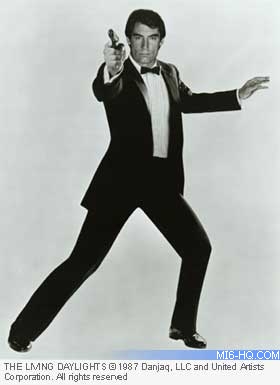 Above: Timothy Dalton in the classic James Bond gun-barrel pose. The iconic image would feature in "The Living Daylights" promotional campaign. |
Dalton was reluctant, but finally agreed and he was tested on a couple of scenes from "On Her Majesty’s Secret Service" as a lover and as a killer and all his years of training and experience showed.
On 6 August 1986, EON announced that they had their new Bond - Welshman Timothy Dalton. Dalton won the approval of Sean Connery, who wished him well and gave his endorsement of the new Bond.
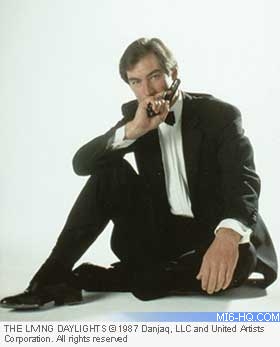 Above: A promotional shot of Dalton for "The Living Daylights" |
Brushes With Bond In a 1987 interview on "Good Morning America", Dalton said he turned down the role in 1971 because he was "too young" for it, and because of the imposing legacy of Sean Connery. Dalton had been approached by Broccoli again in 1982, when it looked like Moore was going to resist playing Bond again in "Octopussy" (1983). Dalton later said of his Bond screentests, "There was a time when Sean Connery gave up the role. I guess I, alongside quite a few other actors, was approached about the possibility of playing the part. That was for "On Her Majesty's Secret Service". I was very flattered, but I think anybody would have been off their head to have taken over from Connery. I was also too young, Bond should be a man in his mid-thirties, at least - a mature adult who has been around." |
"I was not approached for "Live And Let Die", but there was a time in the late 1970s, when Roger may not have done another one, for whatever reason. They were looking around then, and I went to see Mr. Broccoli in Los Angeles. At that time, they didn't have a script finished and also, the way the Bond movies had gone - although they were fun and entertaining - weren't my idea of Bond movies. They had become a completely different entity. I know Roger, and think he does a fantastic job, but they were different kinds of movies. Roger is one of the only people in the world who can be fun in the midst of all that gadgetry. But in truth my favourite Bond movies were always "Dr. No", "From Russia With Love", and "Goldfinger"."
The Living Daylights With his tough approach to the James Bond character, Dalton radically reversed the on-screen image of Bond and returned the character to the 007 Ian Fleming wrote about. Clearly, this came as a shock to Roger Moore fans who were quite at ease with Moore's laid-back approach to the character. Dalton publicly announced a desire to get back to "Fleming's Bond" and was quite successful at it. Dalton's debut Bond outing "The Living Daylights" had its premiere on 29 June 1987 at the usual venue, the Odeon Leicester Square in London. MGM/UA had ambitious plans for the film, striking an unprecedented 250 prints for its nationwide release on 10 July. |
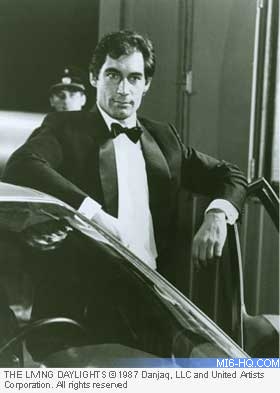 Above: Dalton in "The Living Daylights" |
In the States the film opened on the 31 July and didn't do as well as EON or MGM/UA might have hoped - the downward slide in admissions that had marred the progress of the series through the 80s continued, US cinemas admitting just 14.2 million punters, the lowest number since "The Man With The Golden Gun" (1974). Worldwide gross was encouraging, but lower than was expected. The grand overhaul seemed to have failed.
Licence To Kill
With "The Living Daylights" still
on general release and doing less well than anyone might have
hoped, EON set about preparing the next Bond adventure. "Licence
To Kill" was going to break with the Bond tradition
in a number of ways.
It was at this point that the series took a dramatic turn by changing the mission from saving the world to a personal vendetta: avenging the brutal attack on Bond's longtime CIA friend, Felix Leiter. It became the first Bond film to receive an PG-13 rating because of the level of onscreen violence and realism.
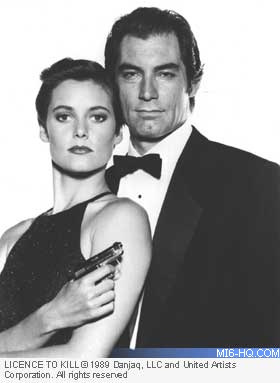 Above: Dalton poses with Bond girl Carey Lowell for a "Licence To Kill" promotion shot |
The British and world premiere on Tuesday 13 June 1989 was a predictable enough affair - it was held at the Odeon Leicester Square. Though the premiere was also attended by former Bond girls Jane Seymour and Britt Ekland, there was a noticeable lack of interest in the media and the crowds that gathered outside the Odeon were noticeably smaller than was usual for such events. The film opened in the States on 14 July and found itself going head to head with a summer full of blockbuster action movies, including "Lethal Weapon 2", "Indiana Jones and the Last Crusade" and "Batman". Despite EON's best efforts to endear the film to the American market by setting it on their doorstep and filling the supporting cast with American actors, "Licence To Kill" came of worst in the summer box office battle. With admissions dropping to 11.7 million, the all-important Stateside gross of $34,667,015 didn't even manage to cover the negative costs of $35 million. The worldwide gross for the film was also worryingly low [just $156,200,000] and MGM/UA were starting to get nervous. Broccoli too was beginning to wonder if the fizz was going out of his 27-year old franchise. |
Not long after "Licence To Kill" was released, Broccoli put EON's parent company, Danjaq, up for sale. MGM/UA were still interested enough in Bond to make preliminary advances on Danjaq but were put off when Broccoli announced his asking price - a hefty £200 million.
Bond 17
What happened next was to keep Bond off the screens for another
six years. During this
period, Broccoli attempted to kickstart the 17th
James Bond adventure a number of times, but ultimately, the
legal wranglings stalled attempts at production until 1994. The
various treatments and scripts developed for Dalton's third outing
were all scrapped when writer Michael France was brought in to
develop what would eventually become "GoldenEye".
Dalton was candid in a 1989 magazine interview on the state of affairs: "My feeling is this will be the last one. I don`t mean my last one. I mean the end of the whole lot. I don`t speak with any real authority, but it`s sort of a feeling I have. Sorry!". Ultimately, Dalton would be proved partially correct, as he never returned to the role. Licence Revoked It was there that Dalton made, and subsequently announced, his decision to walk way. On 12 April 1994, the bombshell was dropped - Timothy Dalton was refusing to come back to the fold. He'd signed up for three films, but it was now five years since his last outing as Bond and he felt the time had come to move on. This saved Broccoli, who was reportedly under pressure from MGM, from having to "fire" the actor. EON opted not to stand in his way and set about searching for his replacement. |
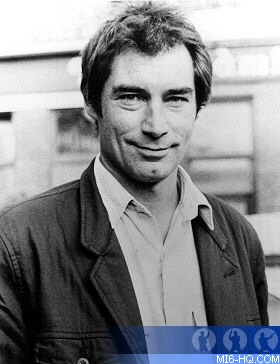 Above: It was planned for Timothy Dalton to return to the role for a third 007 film, but legal wranglings with the studio caused a five year delay that ultimately caused him to call time on his tenure as James Bond. |
Dalton said at the time, "Even though the (producers) have always made it clear to me that they want me to resume my role in their next James Bond feature, I have now made this difficult decision. As an actor, I believe it is now time to leave that wonderful image behind and accept the challenge of new one’s." When Dalton was interviewed on Tom Snyder’s programme he added that "He had been Bond to the world for 8 years and that it was time to move on or he would be wearing the mantle for the rest of his life."
Retrospective
The onscreen portrayal of Bond by Dalton was dark, gritty and
more realistic than anything that had been seen before, and
his
return to the roots of Ian Fleming's character proved to be
a double-edged sword. Critics and fans of Fleming's original
novels
welcomed a more serious interpretation, however, the reaction
of Moore aficionados and those who had grown up with Bond
in the
70's and 80's were mixed, as most of them were generally unfamiliar
with Fleming's original novels. Looking back at Dalton's
two 007
films today, both "The Living
Daylights" and "Licence
To Kill" hold up well, the latter more so, especially
when compared some of Moore's outings. The debate on whether
Dalton's
tenure as 007 was a success or failure still rages on.
Share The Story

Recently Published
Features


New Audiobooks
Literary IFP has announced new readings of Ian Fleming novels
Deep Fake 007s
Videos A new short film explores deep fake technology with James Bonds
Collector Extraordinaire
Interviews Ahead of auctioning his impressive Bond collection, Steve Oxenrider reflects on half a century of collecting 007
